
The Different Types of Eyelid Surgery
The Complete Guide to Blepharoplasty: Types, Techniques, and Why Plastic Surgeons Set the Standard for Natural Results
At Faceliftology, we cut through the marketing noise and deliver the anatomical truth about facial rejuvenation procedures. Blepharoplasty, commonly called eyelid surgery, is one of the most transformative yet subtle operations in facial plastic surgery. It doesn’t just “lift” the lids; it restores the youthful architecture of the periorbital region, the delicate area surrounding the eyes that reveals age faster than almost any other facial zone.
Unlike resources written from a purely ophthalmologic perspective (which often focus on functional vision correction), this guide is built for patients seeking cosmetic and aesthetic harmony. Board-certified plastic surgeons who specialize in facial procedures approach blepharoplasty as part of a comprehensive facial rejuvenation strategy, frequently combining it with facelift techniques to avoid the “operated” look and achieve balanced, natural outcomes that last.
Here’s everything you need to know about the different types of eyelid surgery, modern techniques, candidacy, recovery, and how to choose the right expertise.
Table of Contents
- Eyelid Anatomy and How Aging Changes Everything
- The Main Types of Blepharoplasty
- Upper Blepharoplasty
- Lower Blepharoplasty
- Asian (Double Eyelid) Blepharoplasty
- Ptosis Repair (Often Combined with Upper Blepharoplasty)
- Revision Blepharoplasty
- Combined and Adjunctive Blepharoplasty Procedures
- Comparison of Blepharoplasty Types
- Who Is a Good Candidate?
- Eyelid Surgery Recovery
- Risks, Complications, and How Expert Surgeons Minimize Them
-
Why Choose a Board-Certified Plastic Surgeon for Blepharoplasty?
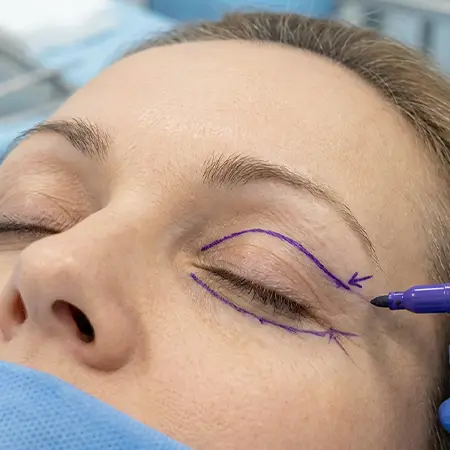
Eyelid Anatomy and How Aging Changes Everything
The eyelids are among the thinnest and most mobile tissues in the body. Key structures include:
- Skin and orbicularis oculi muscle (the sphincter that closes the eye).
- Orbital septum (a fibrous barrier).
- Fat pads (two in the upper lid, three in the lower lid: medial, central, and lateral).
- Levator aponeurosis and Müller’s muscle (the elevators that open the eye).
- Canthal tendons (inner and outer anchors that maintain lid position and shape).
With age, skin loses elasticity (dermatochalasis), fat pads prolapse or atrophy, the septum weakens, and the brow may descend. This creates:
- Hooded or heavy upper lids.
- “Bags,” hollows, or dark circles under the eyes.
- A tired, sad, or angry expression, even when you feel rested.
Plastic surgeons address these changes while preserving natural eyelid function and avoiding hollowing or distortion, These are issues that can arise when the procedure is treated in isolation rather than as part of overall facial aging.
The Main Types of Blepharoplasty: Upper, Lower, and Specialized Approaches
Blepharoplasty is not one-size-fits-all. The technique is chosen based on your anatomy, goals, and whether the issue is primarily excess skin, fat, muscle laxity, or a combination.
Upper Blepharoplasty
The most common eyelid procedure worldwide, upper blepharoplasty corrects dermatochalasis (excess skin), orbicularis hypertrophy, prolapsed fat, and sometimes subtle brow descent that contributes to hooding.
Core Technique A precise incision is placed in the natural supratarsal crease (typically 7–11 mm above the lash line in women, slightly lower in men). Skin and a conservative strip of orbicularis muscle are excised. The orbital septum is opened only as needed to access the two upper-lid fat pads (medial and central). Modern plastic surgeons avoid aggressive fat removal; instead, they perform selective debulking or fat preservation/repositioning to maintain youthful upper-lid volume and prevent the deep superior sulcus (hollowed “sunken eye”) deformity that plagued older techniques.
Key Variations
- Skin-only upper blepharoplasty: Ideal for younger patients or those with excellent muscle tone and minimal fat. No muscle or fat is touched, purely a skin redraping.
- Upper blepharoplasty with fat management: Fat is either conservatively trimmed, cauterized, or repositioned laterally or superiorly to smooth contour.
- Upper blepharoplasty with internal browpexy: Sutures anchor the brow fat pad to the periosteum through the same lid incision, stabilizing mild brow ptosis without a separate brow lift.
- Combined with ptosis repair (see Ptosis Repair section below): When the lid margin itself droops due to levator aponeurosis attenuation.
Board certified plastic surgeon pro tip: Evaluation the entire periorbital–brow–midface unit of the upper-lid is key to surgical approach so result blends seamlessly with the rest of the face rather than creating an isolated “eye job.”
Lower Blepharoplasty
Lower-lid surgery is more complex because the lower lid must support the globe, maintain shape, and blend with the cheek. Aging produces fat prolapse, tear-trough hollowing, lid laxity, and skin excess. The modern gold standard is volume preservation rather than subtraction.
Two Primary Approaches
- Transconjunctival (internal, scarless) lower blepharoplasty Incision hidden inside the conjunctiva. Ideal for patients with good skin tone and primarily fat pseudoherniation. Allows direct access to the three lower-lid fat pads (medial, central, lateral) without risking external scar or orbicularis damage.
- Transcutaneous (subciliary/external) lower blepharoplasty Tiny skin incision 1–2 mm below the lashes. Used when true skin excess exists. The skin-muscle flap is elevated, fat managed, and excess skin conservatively excised. Higher risk of lower-lid malposition if not combined with canthal support, which is why only experienced facial plastic surgeons should perform it.
Deep Dive: Fat Repositioning Techniques – The Modern Gold Standard Traditional lower blepharoplasty simply excised fat, which often led to hollowing and a skeletonized appearance years later. Today’s plastic surgeons reposition rather than remove fat in most cases.
How it works:
- The orbital septum is opened, and the medial and central fat pads are mobilized as vascularized pedicles (still attached to their blood supply).
- The arcus marginalis (the ligament tethering the septum to the orbital rim) is fully released.
- The fat is transposed over the inferior orbital rim into the tear-trough hollow and secured with fine sutures (often 5-0 or 6-0 nylon or barbed sutures) to the periosteum or deep cheek tissues.
- The lateral fat pad is usually conservatively trimmed because it is smaller and less useful for transposition.
This creates a smooth lid-cheek junction, eliminates the “double bubble” or dark circle shadow, and restores the youthful convex contour. Some surgeons add SOOF (sub-orbicularis oculi fat) repositioning or micro-fat grafting for even more volume when needed. Results look natural because you are using the patient’s own tissue in its anatomically correct position. Recovery is similar to standard blepharoplasty, but longevity is dramatically improved and less likely to generate an “operated” hollow look over time.
Pinch Lower Blepharoplasty A minimalist variation for patients with very mild skin excess and excellent tone. Only a small “pinch” of skin and muscle is removed after transconjunctival fat work. Extremely low risk of lid retraction.
Canthal Support (Canthopexy or Canthoplasty) Frequently added to any lower blepharoplasty. A canthopexy tightens the lateral canthal tendon without cutting it; a canthoplasty divides and resuspends it higher and tighter. Prevents rounding, scleral show, or ectropion, especially important in patients with lax lids or negative vector orbits.
Asian (Double Eyelid) Blepharoplasty
This specialized procedure creates or enhances a supratarsal crease in eyelids that lack one (monolids), while respecting ethnic identity and avoiding Westernization.
Historical Note The modern history of Asian blepharoplasty traces directly back to the pioneering work of Dr. Ralph Millard while he served as chief plastic surgeon for the U.S. Marine Corps in South Korea during the Korean War. Dr. Millard refined and popularized reliable techniques for creating a natural-looking double eyelid, transforming the field and making the procedure accessible and reproducible worldwide.
Techniques (Tailored to Anatomy) Asian eyelids typically have lower fusion of the orbital septum, more preaponeurotic fat, and a thicker orbicularis. Three main approaches exist:
- Non-incisional (suture) method: Quick, minimal downtime. Sutures create the crease by plicating skin to the levator aponeurosis. Best for thin lids with little fat.
- Partial-incision method: Small 3–5 mm incisions for precise fat sculpting and crease formation.
- Full-incisional method: Gold standard for most patients. Allows complete debulking of pretarsal and preaponeurotic fat, levator fixation, and skin excision if needed. The crease height and shape (parallel, tapered, or fan-shaped) are customized to the patient’s facial proportions.
Fat preservation or minimal repositioning is emphasized to avoid hollowing. Epicanthoplasty (medial fold release) may be added for wider eyes when requested. The result is a crisp, natural crease that opens the eye while preserving Asian beauty.
Ptosis Repair (Often Combined with Upper Blepharoplasty)
True ptosis involves a drooping lid margin (not just excess skin). Plastic surgeons repair the levator aponeurosis (internal or external approach) or, in severe cases, use a frontalis sling. This restores the lid’s natural resting position while simultaneously addressing hooding, creating brighter, more alert eyes.
Revision Blepharoplasty
One of the most demanding procedures in facial plastic surgery. Common issues from prior surgery include hollowing, asymmetry, crease irregularities, lower-lid retraction, or “overdone” appearance. Revision typically requires scar release, volume restoration (fat grafting or repositioning), canthal reconstruction, and often skin grafting or laser resurfacing. Revision blepharoplasty can be meticulous in nature depending on cosmetic and/or reconstructive goals.
Combined and Adjunctive Blepharoplasty Procedures
- Upper + lower blepharoplasty in one session: Most common combination when cosmetic goals include both upper and lower eyelid rejuvenation.
- Blepharoplasty + facelift/neck lift: The eyes and lower face age as a unit; combining eyelid surgery with facelift often prevents disharmony. When indicated, lower eyelid and cheek blending can be addressed when combining both procedures.
- Blepharoplasty + laser resurfacing or chemical peel: Addresses fine wrinkles and skin quality the scalpel cannot. Not always indicated to combine. Patient selection and cosmetic goals need to be considered. Many surgeons recommend performing skin resurfacing after surgical incisions have healed. At which point, resurfacing can more likely be performed over surgical incisions.
- Blepharoplasty + midface lift or fat grafting: Restores cheek volume for seamless lid-cheek transition. Fat grafting to upper eyelids can help reduce the “sunken eye” appearance, while fat grafting to the lower eyelid area is often performed to address volume loss around the orbital rim and tear trough area.
Comparison of Blepharoplasty Types
At Faceliftology, we believe informed patients make the best decisions. This side-by-side comparison distills decades of operating-room experience into the key differences that matter most when choosing the right eyelid procedure. Every column reflects real surgical decision-making—not generic checklists.
| Procedure Type | Primary Concerns Addressed | Incision Location | Fat Management Technique | Canthal Support (Canthopexy/Canthoplasty) | Ideal Candidate Profile | Typical Recovery Downtime | Common Combinations | Level of Surgical Complexity |
|---|---|---|---|---|---|---|---|---|
| Upper Blepharoplasty | Dermatochalasis (excess skin hooding), orbicularis hypertrophy, upper-lid fat prolapse, mild brow descent | Hidden in natural supratarsal crease (7–11 mm above lashes) | Conservative trimming or lateral/superior repositioning to preserve volume and avoid hollow superior sulcus | Rarely needed (internal browpexy often added instead) | Patients with heavy, tired upper lids; good skin elasticity; realistic expectations | 7–10 days (sutures out at day 5–7; makeup-ready by day 8–10) | Internal browpexy, ptosis repair, facelift, laser resurfacing | Medium |
| Lower Blepharoplasty – Transconjunctival (Scarless) | Under-eye bags (fat prolapse), tear-trough hollowing; minimal skin excess | Internal (inside lower lid conjunctiva) – no external scar | Gold-standard fat repositioning (medial/central pads transposed over orbital rim as vascularized pedicles) or selective removal | Often added for lid support | Younger patients or excellent skin tone; primarily fat pseudoherniation; negative-vector orbits | 5–7 days (minimal bruising; back to work with concealer by day 7) | Upper blepharoplasty, midface fat grafting, facelift | High (requires precise orbital anatomy mastery) |
| Lower Blepharoplasty – Transcutaneous (Subciliary) | Fat prolapse + true excess lower-lid skin, laxity, tear-trough deformity | External, 1–2 mm below lashes | Fat repositioning (preferred) or conservative removal + skin redraping | Almost always included to prevent retraction or rounding | Patients with visible skin excess and moderate laxity; older patients needing skin tightening | 10–14 days (slightly more swelling/bruising; full makeup by day 10–12) | Upper blepharoplasty, pinch skin excision, facelift/neck lift | Very High (higher risk profile demands advanced canthal expertise) |
| Asian (Double Eyelid) Blepharoplasty | Absent or low supratarsal crease (monolid); excess pretarsal fat; epicanthal folds (optional) | Non-incisional (suture only), partial-incision, or full incisional crease | Minimal debulking or preservation of preaponeurotic fat; precise levator fixation | Not typically required unless combined with epicanthoplasty | East Asian patients seeking natural crease while preserving ethnic identity; thin to moderate lids | 5–10 days (suture method fastest; full-incisional similar to upper) | Epicanthoplasty, upper blepharoplasty, laser for fine lines | Medium to High (anatomy-specific; demands cultural sensitivity and precision) |
| Ptosis Repair (Levator Advancement or Frontalis Sling) | True drooping of the lid margin (not just skin hooding); levator aponeurosis attenuation | Usually internal (via same upper blepharoplasty incision) or external skin crease | Minimal (focus is on muscle/tendon repair) | Rarely needed | Patients with lid margin sitting too low (covers part of pupil); often combined with dermatochalasis | 7–10 days (same as upper blepharoplasty) | Upper blepharoplasty, browpexy | High (functional + aesthetic balance critical to avoid over- or under-correction) |
| Revision Blepharoplasty | Hollowing, asymmetry, crease irregularities, lower-lid retraction, “overdone” or “surprised” look from prior surgery | Utilizes or revises existing scars; may require skin grafting or laser | Volume restoration via fat repositioning, fat grafting, or SOOF repositioning | Almost always required (canthal reconstruction common) | Patients unhappy with previous eyelid surgery; scar tissue, volume loss, or malposition | 14–21 days (more swelling; staged recovery common) | Fat grafting, laser resurfacing, full facial rejuvenation | Highest (most technically demanding; requires extensive primary experience) |
Who Is a Good Candidate? The Plastic Surgeon’s Evaluation
Ideal candidates are in good health, non-smokers (no nicotine use), and have realistic expectations. During consultation, a board-certified plastic surgeon will:
- Assess skin quality, fat distribution, lid tone, tear production, and brow position.
- Perform a full facial analysis to determine if isolated blepharoplasty or a combined rejuvenation plan is best.
- Review medical issues (dry eyes, thyroid eye disease, etc.).
Functional blepharoplasty (vision obstruction) may be covered by insurance in some cases; pure cosmetic cases are not.
The Procedure Day: What to Expect
Blepharoplasty is usually performed as an outpatient procedure in an accredited surgical facility. Depending on the specific type of blepharoplasty to be performed, board-certified plastic surgeons work alongside experienced anesthesiologists to carry out the procedure with careful attention.
Anesthesia options are usually tailored to the patient’s medical history, type of procedure to be performed and extent of surgery. The three main choices include:
- Local anesthesia: The eyelids are numbed while the patient remains awake and comfortable.
- Sedation (also known as twilight or IV sedation): The patient is deeply relaxed and drowsy but breathes independently.
- General anesthesia: The patient is fully asleep throughout the procedure.
.
How long does the surgery take?
The surgery itself typically takes 1–2 hours when both upper and lower eyelids are treated in one session. When combined with other procedures such as a facelift, the total time is longer.
Eyelid Surgery Recovery
Most patients find the surgical day less stressful than anticipated. Clear postoperative instructions should be provider before leaving the facility, though many plastic surgeons provide post-operative instructions prior to surgery so the patient can plan according to their specific recovery directions.
Healing Timeline and Realistic Expectations
Recovery is remarkably straightforward when performed by an experienced facial plastic surgeon:
- Days 1–3: Mild swelling and bruising. Cold compresses and head elevation help.
- Week 1: Sutures removed. Most patients return to work or social activities with makeup/concealer.
- Weeks 2–4: Bruising fades; swelling continues to resolve.
- Months 3–6: Final subtle refinements appear as tissues settle.
Full results last 7–15+ years (upper lids often longer than lower). Lifestyle, genetics, and sun protection influence longevity. Combined facelift patients often note that the eyes and midface “age together” more gracefully.
Risks, Complications, and How Expert Surgeons Minimize Them
All surgery carries risks, but in the hands of board-certified plastic surgeons specializing in the face, serious complications are rare. Common (and usually temporary) issues include dry eyes, asymmetry, or minor lid lag. Rare risks include infection, scarring, or vision changes. Prevention comes from meticulous technique, proper patient selection, and postoperative care.
Why Choose a Board-Certified Plastic Surgeon for Blepharoplasty?
Ophthalmologists and oculoplastic surgeons are highly trained in eye health and functional lid surgery. However, board-certified plastic surgeons bring comprehensive training in facial aesthetics and harmony. They understand how eyelid changes interact with brow position, midface volume, and jawline contour which are key for avoiding the isolated “eye job” look.
Medical Disclaimer – Faceliftology®
The information provided on Faceliftology® is intended for general educational and informational purposes only and reflects general medical concepts related to facial aging and facelift procedures. It is not intended to constitute medical advice, diagnosis, or treatment recommendations, nor does it establish a physician–patient relationship.
Faceliftology® is an independent educational platform. Any medical or surgical information presented, including content that is reviewed or contributed to by a physician, is provided in a general context and does not represent individualized medical guidance.
Facelift surgery and related facial procedures involve highly individualized decision-making based on a patient’s anatomy, medical history, surgical technique, and overall health status. Outcomes, recovery timelines, and healing responses vary significantly between individuals and cannot be predicted or guaranteed.
Discussion of surgical techniques, adjunctive therapies, recovery strategies, nutritional considerations, or postoperative care reflects general principles described in clinical practice and medical literature. Such information does not imply that any specific approach is appropriate, necessary, or effective for a particular patient.
Users of this website should not rely on any content as a substitute for consultation with a qualified healthcare provider. All medical decisions, including whether to undergo surgery or pursue any aspect of preoperative or postoperative care, should be made in direct consultation with a board-certified plastic surgeon or other appropriately trained medical professional.
By using this website, you acknowledge that any reliance on the information provided is at your own discretion and risk.
Faceliftology® does not endorse or promote any specific treatment, provider, product, or technique unless explicitly stated. Inclusion of information does not imply superiority over other medically accepted approaches.
In the event of a medical concern, complication, or unexpected symptom, individuals should seek prompt evaluation by their surgeon or a qualified healthcare provider.
Content on this website may not reflect the most current medical developments and should not be interpreted as comprehensive or definitive medical guidance.
Facelift Planning Resources
Choosing the right facelift technique is just as important as choosing the right surgeon. These guides can help you better understand your options.