
Deep Plane Facelift: Technique, Anatomy, and Clinical Considerations
What Is a Deep Plane Facelift?
The deep plane facelift is an advanced facial rejuvenation technique that addresses aging by repositioning deeper facial structures as a unified, composite layer. The modern deep plane approach was popularized by Dr. Sam T. Hamra in the early 1990s, representing a significant evolution in facelift surgery.
Unlike more superficial techniques, this method involves dissection beneath the superficial musculoaponeurotic system (SMAS), allowing for release of key retaining ligaments and mobilization of the midface. By working within this deeper anatomical plane, the surgeon can reposition both skin and underlying tissues together, rather than tightening them separately.
This approach enables more comprehensive correction of facial descent, particularly in the nasolabial folds, midface, and jawline. As a result, the deep plane facelift is typically recommended for patients with moderate to advanced facial aging who require more extensive structural rejuvenation.
The technique builds upon earlier SMAS-based procedures but emphasizes anatomical continuity and tension-free redraping of the skin, which can contribute to more natural-looking results.
Key Takeaways: Deep Plane Facelift
- Advanced structural technique: A deep plane facelift repositions deeper facial tissues beneath the SMAS, rather than tightening skin alone
- Comprehensive correction: Effectively addresses midface descent, nasolabial folds, and jawline sagging in a single procedure
- Ligament release is key: Releasing retaining ligaments allows for more complete and natural repositioning of facial structures
- Tension-free results: Skin is redraped without bearing the primary lift, helping avoid an overly tight or “pulled” appearance
- Best for advanced aging: Typically recommended for patients with moderate to advanced facial laxity and deeper structural changes
- More complex procedure: Requires advanced surgical expertise and detailed knowledge of facial anatomy
- Long-lasting improvement: Deeper repositioning may contribute to more durable and stable results over time
Understanding the Deep Plane: Facial Anatomy Explained
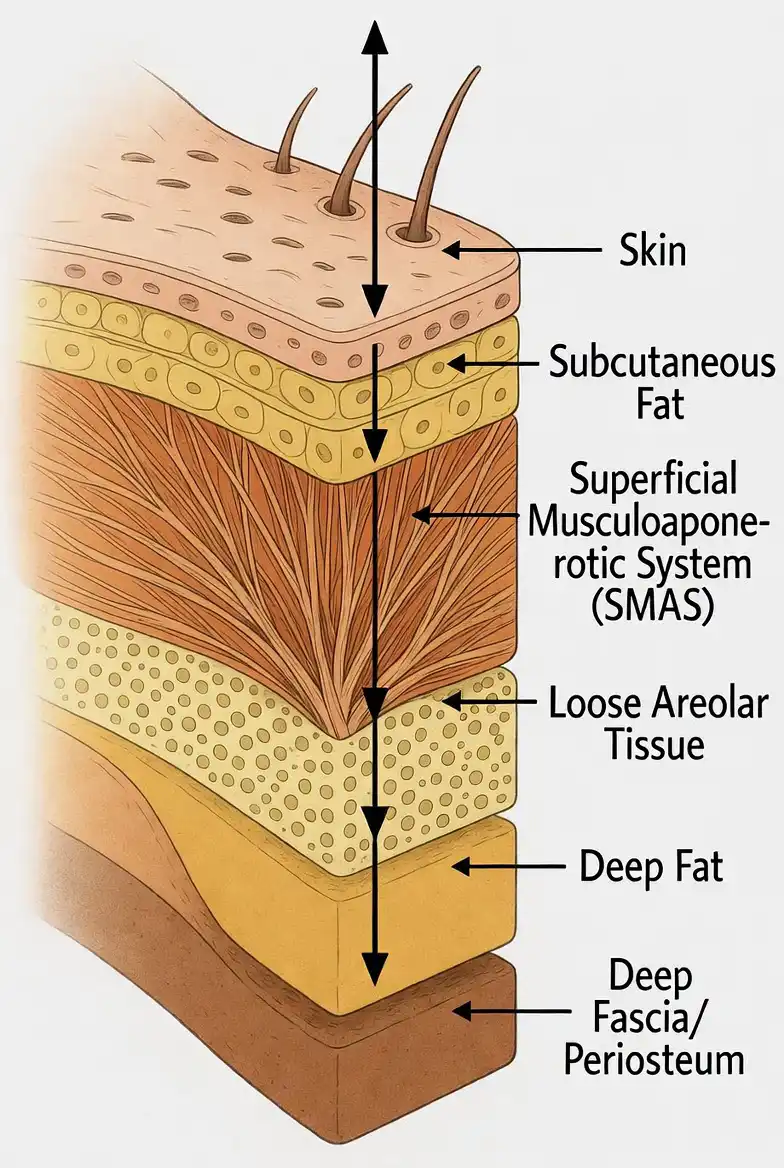
A detailed understanding of layered facial anatomy is essential for appreciating the rationale and execution of the deep plane facelift.
Skin and Subcutaneous Tissue
The superficial layers reflect visible aging changes but are not the primary focus of correction in this technique. Skin is redraped after deeper structural repositioning.
Superficial Musculoaponeurotic System (SMAS)
The SMAS serves as the entry point to the deeper plane. In the deep plane facelift, dissection proceeds beneath this layer, maintaining its continuity with overlying tissues.
Retaining Ligaments
Key retaining ligaments—including the zygomatic and masseteric ligaments—anchor facial soft tissues to underlying structures. These ligaments contribute to the formation of nasolabial folds and midface descent.
A defining component of the deep plane facelift is the release of these retaining ligaments, allowing for mobilization of the midface and more comprehensive repositioning.
Midface Fat Compartments
The malar fat pad and associated compartments descend with age, contributing to volume loss in the midface and deepening of facial folds. The deep plane technique allows for repositioning of these structures without direct fat manipulation.
Facial Nerve Considerations
Dissection occurs in proximity to branches of the facial nerve, requiring precise anatomical knowledge and careful technique to minimize risk.
How a Deep Plane Facelift Is Performed
The deep plane facelift differs from other techniques primarily in the depth of dissection and extent of ligament release.
Incision Design
Incisions are typically similar to those used in SMAS facelifts, extending along the hairline and around the ear. Adequate exposure is necessary to safely perform deeper dissection.
Skin Elevation
Initial skin elevation is more limited than in traditional SMAS techniques, as the procedure relies less on wide subcutaneous undermining.
Entry into the Deep Plane
Dissection proceeds beneath the SMAS layer, entering the sub-SMAS plane. The SMAS and overlying skin are maintained as a composite flap.
Ligament Release
Key retaining ligaments are carefully released, allowing the midface and lower facial tissues to be mobilized as a single unit. This step is central to achieving more complete correction of facial descent.
Composite Tissue Repositioning
The SMAS, skin, and associated soft tissues are elevated together and repositioned in a more youthful orientation. Because the skin is not bearing the primary tension, redraping is more natural.
Fixation
The repositioned tissues are secured using sutures anchored to stable structures. Skin closure is performed with minimal tension.
Who Is a Good Candidate for a Deep Plane Facelift?
The deep plane facelift is best suited for patients with more advanced structural aging of the face, particularly when changes extend beyond superficial skin laxity into deeper tissues.
Ideal candidates typically present with:
- Moderate to advanced facial aging
- Prominent nasolabial folds
- Midface descent with volume shift
- Significant jowling along the jawline
- Loss of lower facial definition
Because this technique repositions deeper facial structures, it is generally less appropriate for individuals with only mild laxity or early signs of aging, where less invasive procedures may provide sufficient improvement.
As with all facelift techniques, candidacy is determined by anatomical presentation and tissue behavior rather than chronological age alone.
Benefits of the Deep Plane Facelift
The deep plane facelift offers several distinct advantages:
- Comprehensive Structural Repositioning: Addresses both the midface and lower face
- Improved Midface Correction: Directly targets descent contributing to nasolabial folds
- Tension-Free Skin Redraping: Reduces reliance on skin for lift, improving natural appearance
- Potential for Greater Longevity: Deeper repositioning may contribute to more durable outcomes
- Unified Tissue Movement: Maintains anatomical relationships by elevating tissues as a composite unit
Limitations and Considerations
Despite its advantages, the deep plane facelift has important considerations:
- Technical Complexity: Requires advanced anatomical knowledge and surgical precision
- Operative Time: Typically longer than more superficial techniques
- Recovery Duration: May involve more prolonged swelling and healing
- Risk Profile: Dissection occurs closer to facial nerve branches, requiring careful technique
- Variability in Execution: Outcomes depend significantly on surgeon expertise and experience with deep plane anatomy
Recovery and Healing Considerations
Recovery following a deep plane facelift reflects the more extensive repositioning of deeper facial structures, which can result in a more noticeable early healing phase compared to less invasive techniques.
Patients can generally expect:
- More pronounced swelling and bruising in the first 1–2 weeks
- Return to social activity within approximately 2–3 weeks, depending on individual healing
- Residual swelling that gradually improves over several weeks to months
Although the initial recovery period may be more visible, long-term healing and final results follow a similar trajectory to other facelift procedures. For a more detailed breakdown of each stage, see our complete facelift recovery guide.
How Long Does a Deep Plane Facelift Last?
The longevity of the deep plane facelift is attributed to repositioning of deeper anatomical structures and release of retaining ligaments. By addressing the underlying causes of tissue descent, the procedure reduces reliance on superficial tension.
This approach may provide more sustained improvement in midface contour and nasolabial fold softening compared to more superficial techniques. However, long-term outcomes are influenced by individual aging patterns, tissue quality, and environmental factors.
How This Technique Compares to Other Facelift Types
The deep plane facelift represents one of the most anatomically comprehensive approaches within the spectrum of facelift techniques. It extends beyond the SMAS facelift by incorporating ligament release and midface mobilization, allowing for more extensive correction.
Compared to a mini facelift, it provides significantly greater structural repositioning. Compared to a SMAS facelift, it offers more direct correction of midface descent and nasolabial folds.
These distinctions are explored in detail in comparison articles evaluating technique, outcomes, and patient selection.
References
- Mitz V, Peyronie M. The superficial musculo-aponeurotic system (SMAS) in the parotid and cheek area. Plastic and Reconstructive Surgery. 1976.
- Hamra ST. The deep-plane rhytidectomy. Plastic and Reconstructive Surgery.
- Baker DC. Lateral SMASectomy and extended SMAS techniques. Clinics in Plastic Surgery.
- Aston SJ, Steinbrech DS, Walden JL. Aesthetic Plastic Surgery. Elsevier.
- Neligan PC. Plastic Surgery: Volume 2: Aesthetic Surgery. Elsevier.

About the Author
Dr. Paul S. Howard is a retired, board-certified plastic surgeon who specialized in both reconstructive and cosmetic plastic surgery procedures. Over the course of his career, he earned national recognition for his surgical skill, commitment to patient care, and contribution to the advancement of plastic surgery techniques. Dr. Howard received world-class training under two legendary pioneers in the field: Dr. Ralph Millard, a leader in cleft and craniofacial surgery, and Dr. Paul Tessier, widely regarded as the father of modern craniofacial surgery. Their influence helped shape Dr. Howard’s meticulous, patient-focused approach to surgery and deepened his lifelong passion for medical history, especially the history of plastic surgery.

Dr. Ralph Millard & Dr. Paul S. Howard
Medical Disclaimer – Faceliftology®
The information provided on Faceliftology® is intended for general educational and informational purposes only and reflects general medical concepts related to facial aging and facelift procedures. It is not intended to constitute medical advice, diagnosis, or treatment recommendations, nor does it establish a physician–patient relationship.
Faceliftology® is an independent educational platform. Any medical or surgical information presented, including content that is reviewed or contributed to by a physician, is provided in a general context and does not represent individualized medical guidance.
Facelift surgery and related facial procedures involve highly individualized decision-making based on a patient’s anatomy, medical history, surgical technique, and overall health status. Outcomes, recovery timelines, and healing responses vary significantly between individuals and cannot be predicted or guaranteed.
Discussion of surgical techniques, adjunctive therapies, recovery strategies, nutritional considerations, or postoperative care reflects general principles described in clinical practice and medical literature. Such information does not imply that any specific approach is appropriate, necessary, or effective for a particular patient.
Users of this website should not rely on any content as a substitute for consultation with a qualified healthcare provider. All medical decisions, including whether to undergo surgery or pursue any aspect of preoperative or postoperative care, should be made in direct consultation with a board-certified plastic surgeon or other appropriately trained medical professional.
By using this website, you acknowledge that any reliance on the information provided is at your own discretion and risk.
Faceliftology® does not endorse or promote any specific treatment, provider, product, or technique unless explicitly stated. Inclusion of information does not imply superiority over other medically accepted approaches.
In the event of a medical concern, complication, or unexpected symptom, individuals should seek prompt evaluation by their surgeon or a qualified healthcare provider.
Content on this website may not reflect the most current medical developments and should not be interpreted as comprehensive or definitive medical guidance.