
Core Anatomical Difference: SMAS vs Deep Plane Dissection
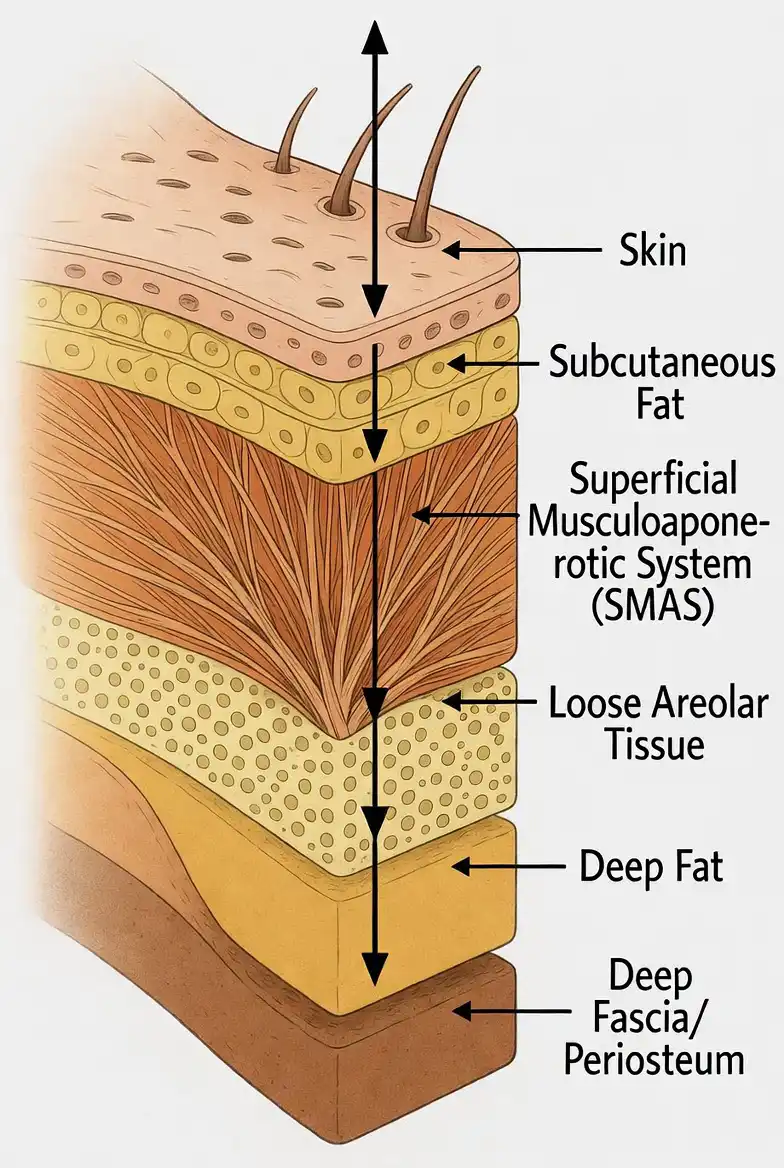
At its core, the difference between these two techniques lies in how the SMAS layer is treated and whether dissection proceeds beneath it. In a SMAS facelift, the SMAS is manipulated from above or within which is folded, tightened, or partially excised without routinely entering the deeper anatomical plane. In a deep plane facelift, the surgeon dissects beneath the SMAS, maintaining its continuity with the overlying skin and elevating both as a single composite unit. This allows for direct access to and release of retaining ligaments. This distinction fundamentally changes both the mechanics of the lift and the anatomical structures affected.Quick Summary: SMAS vs Deep Plane Facelift
- Both procedures treat the same areas (midface + lower face), but differ in depth of dissection and tissue mobilization
- Deep plane facelifts release retaining ligaments, allowing more direct repositioning of midface structures
- SMAS facelifts reposition tissue more indirectly, without full ligament release
- Deep plane may provide more significant improvement in nasolabial folds and cheek position
- Recovery timelines are similar, though deep plane may involve more early swelling
- The best technique depends on anatomy, not preference—and surgeon expertise is critical
Treatment of Retaining Ligaments
Retaining ligaments are a critical factor in differentiating outcomes.
SMAS Facelift
- Ligaments are generally not directly released
- Lift is achieved by tensioning and repositioning the SMAS
- Midface mobility remains partially constrained
Deep Plane Facelift
- Key ligaments (zygomatic, masseteric) are released
- This allows for true mobilization of the midface
- The malar fat pad can be repositioned more effectively
The release of these ligaments is what enables the deep plane technique to address nasolabial folds and midface descent more directly.
Tissue Movement Strategy: Layered vs Composite Repositioning
Another defining difference is how tissues are elevated.
SMAS Facelift
- Skin and SMAS are treated as separate layers
- Skin is redraped after SMAS tightening
- Some degree of tension is still borne by the skin
Deep Plane Facelift
- Skin, SMAS, and underlying fat are elevated as a composite flap
- Movement occurs as a unified structure
- Skin tension is minimized
This composite approach contributes to a more natural transition between facial regions, as tissue relationships are preserved.
Impact on the Midface and Nasolabial Folds
Both SMAS and deep plane facelifts are designed to address aging across the midface and lower face. The key difference is not what areas are treated, but how effectively those areas can be repositioned based on the depth of dissection.
SMAS Facelift
The SMAS facelift elevates and repositions the superficial musculoaponeurotic system to improve overall facial contour across both the midface and lower face. This includes:- Improved jawline definition and reduction of jowls
- Partial correction of midface descent
- Indirect elevation of midface structures due to limited ligament release
- Variable, often modest improvement in nasolabial folds
- Subtle to moderate enhancement of malar (cheek) projection
Deep Plane Facelift
The deep plane facelift operates beneath the SMAS, allowing for release of key retaining ligaments and mobilization of the skin and SMAS as a composite unit. This enables more direct and anatomically complete repositioning of midface structures, including:- Direct elevation of the malar fat pad
- More substantial improvement in the nasolabial fold complex
- More pronounced softening of nasolabial folds
- More effective restoration of cheek volume and position
- A more integrated correction between the midface and lower face
Clinical Implication
Both techniques can improve midface aging, but the depth of dissection determines the degree and mechanism of correction.
For patients with more significant midface descent, cheek flattening, or deeper nasolabial folds, the deep plane approach may allow for more direct and substantial repositioning of these structures.
Side-by-Side Comparison of SMAS vs Deep Plane Facelift
The distinction between a SMAS facelift and a deep plane facelift is fundamentally defined by the level of dissection relative to the SMAS layer and whether retaining ligaments are released.
| Feature | SMAS Facelift | Deep Plane Facelift |
|---|---|---|
| Plane of Dissection | Subcutaneous with SMAS modification | Sub-SMAS (deep plane) |
| SMAS Handling | Plication, imbrication, or partial excision | Maintained as part of a composite flap |
| Retaining Ligament Release | Typically limited or indirect | Direct release of zygomatic and masseteric ligaments |
| Midface Mobilization | Limited | Significant, including malar fat pad repositioning |
| Nasolabial Fold Correction | Modest improvement | More direct and effective softening |
| Skin Tension | Moderate reliance on skin redraping | Minimal (lift achieved through deeper structures) |
| Extent of Dissection | Moderate | More extensive, deeper dissection |
| Longevity of Results | Long-lasting | Potentially longer due to ligament release |
| Technical Complexity | Moderate | High |
| Facial Nerve Proximity | More superficial dissection plane | Closer to facial nerve branches |
Longevity and Structural Durability of Results
Longevity is influenced by the depth of correction and whether foundational constraints are addressed.
The SMAS facelift provides durable results by repositioning a key structural layer. However, because retaining ligaments are not fully released, some vectors of descent remain.
The deep plane facelift, by releasing these constraints and repositioning tissues at a deeper level, may offer greater long-term structural stability. That said, longevity is not solely determined by technique alone, but is also influenced by tissue quality, aging patterns, and surgical execution.
Surgical Complexity and Risk Profile
The deep plane facelift is inherently more technically demanding.
SMAS Facelift
- More standardized and widely performed
- Operates in a relatively safer anatomical plane
- Lower technical barrier
Deep Plane Facelift
- Requires advanced anatomical understanding
- Dissection occurs closer to facial nerve branches
- Greater dependence on surgical precision
Outcomes in both techniques are highly dependent on surgeon expertise, but this dependence becomes more pronounced as procedural complexity increases.
Recovery and Healing Differences
Recovery differences reflect the depth and extent of dissection.
SMAS Facelift
- Moderate swelling and bruising
- Predictable recovery timeline
- Return to social activity typically within 2–3 weeks
Deep Plane Facelift
- Potentially more pronounced early swelling
- Similar overall recovery window, though initial healing may be more noticeable
- Long-term healing trajectory comparable
Despite deeper dissection, modern techniques often result in comparable recovery timelines when performed with careful tissue handling. For more information, please read our guide on facelift recovery.
Patient Selection: Which Facelift Is More Appropriate?
The choice between a SMAS facelift and a deep plane facelift is determined by anatomical needs rather than procedural preference.
SMAS Facelift is generally appropriate for:
- Moderate lower facial aging
- Jowling without significant midface descent
- Patients seeking structural improvement without deeper dissection
Deep Plane Facelift is generally appropriate for:
- Moderate to advanced aging
- Prominent nasolabial folds
- Midface descent
- Patients requiring comprehensive structural repositioning
Appropriate selection depends on:
- Depth of tissue descent
- Ligamentous constraints
- Desired extent of correction
Outcomes in both approaches are influenced by the surgeon’s ability to match technique to anatomy and execute the procedure with precision.
Visual Decision Framework: SMAS vs Deep Plane Facelift
How to Choose Between SMAS and Deep Plane Techniques
Rather than viewing one technique as universally better, the decision depends on the depth of aging and the areas of concern
You May Be a Better Candidate for a SMAS Facelift If:
- You have moderate lower face aging
- Jowls are present but not severe
- Neck laxity is mild to moderate
- Midface descent is minimal
- You want meaningful improvement without the most advanced dissection
You May Be a Better Candidate for a Deep Plane Facelift If:
- You have moderate to advanced facial aging
- There is visible midface descent (cheek flattening)
- Nasolabial folds are pronounced
- You want more comprehensive structural repositioning
- You are seeking the most anatomically complete correction
Simple Decision Guide
- Primarily lower face + jawline concerns → SMAS facelift
- Midface + deeper structural aging → Deep plane facelift
Important Consideration
The most important variable is not just the technique—it is surgeon expertise with that technique.
A well-executed SMAS facelift can outperform a poorly executed deep plane procedure, and vice versa. Technique selection should always align with both:
- Your anatomy
- Your surgeon’s experience and preferred approach
References
- Mitz V, Peyronie M. The superficial musculo-aponeurotic system (SMAS) in the parotid and cheek area. Plastic and Reconstructive Surgery. 1976.
- Hamra ST. The deep-plane rhytidectomy. Plastic and Reconstructive Surgery.
- Baker DC. Lateral SMASectomy and SMAS techniques. Clinics in Plastic Surgery.
- Aston SJ, Steinbrech DS, Walden JL. Aesthetic Plastic Surgery. Elsevier.
- Neligan PC. Plastic Surgery: Volume 2: Aesthetic Surgery. Elsevier.
Medical Disclaimer – Faceliftology®
The information provided on Faceliftology® is intended for general educational and informational purposes only. It is not intended to constitute medical advice, diagnosis, treatment recommendations, or to establish a physician–patient relationship.
Facelift surgery and other cosmetic facial procedures involve individualized medical decision-making based on a patient’s anatomy, medical history, surgical plan, and overall health status. Recovery experiences, healing timelines, and outcomes vary between individuals and cannot be predicted or guaranteed.
Any discussion of surgical techniques, adjunctive therapies, nutritional support, lifestyle considerations, or recovery strategies reflects general principles described in the medical literature and does not imply that such measures are appropriate, necessary, or effective for every patient or procedure.
Patients should always consult directly with a board-certified plastic surgeon or other qualified healthcare professional regarding preoperative preparation, postoperative care, medications, supplements, adjunctive therapies, and activity restrictions. Only the operating surgeon or treating physician can provide recommendations specific to an individual patient’s care.
Faceliftology® does not endorse or promote any specific treatment, therapy, product, or recovery protocol unless explicitly stated, and inclusion of information does not imply superiority over other medically accepted approaches.
In the event of a medical concern, complication, or unexpected symptom following surgery, patients should seek immediate evaluation by their surgeon or an appropriate medical professional.
The content on this website should not be relied upon as a substitute for professional medical judgment, diagnosis, or treatment.