
Mini Facelift vs SMAS Facelift: Key Differences Overview
The primary distinction between a mini facelift and a SMAS facelift lies in the depth and extent of surgical manipulation.
A mini facelift involves limited subcutaneous dissection with optional, conservative SMAS plication. The procedure is designed to improve contour with minimal disruption to deeper anatomical structures.
In contrast, a SMAS facelift routinely involves direct manipulation of the SMAS layer through techniques such as plication, imbrication, or partial excision. This allows for repositioning of deeper facial tissues rather than relying primarily on skin redraping.
As a result, the SMAS facelift is structurally more comprehensive.
Key Takeaways: Mini Facelift vs SMAS Facelift
- The primary difference is depth of correction
A mini facelift works in a more superficial plane, while a SMAS facelift directly repositions deeper structural layers of the face. - Mini facelifts are best for early aging
Ideal for patients with mild skin laxity, early jowling and minimal neck involvement who want subtle refinement. - SMAS facelifts address more advanced changes
Better suited for moderate laxity, established jowls and early neck aging where deeper tissue repositioning is required. - Longevity reflects structural support
Because the SMAS facelift lifts deeper tissues, results tend to last longer than those achieved with a mini facelift. - Recovery differs, but both are manageable
Mini facelifts typically involve shorter downtime, while SMAS procedures require a slightly longer recovery due to deeper dissection. - Procedure selection should match anatomy—not preference
Choosing a less invasive procedure for more advanced aging often leads to under-correction and suboptimal outcomes. - Surgical technique and patient selection drive results
The best outcomes depend on aligning the procedure with the patient’s degree of aging and the surgeon’s expertise in executing the technique.
Depth of Correction and Anatomical Impact
The anatomical impact of each procedure is primarily determined by how deeply the surgeon works beneath the skin.
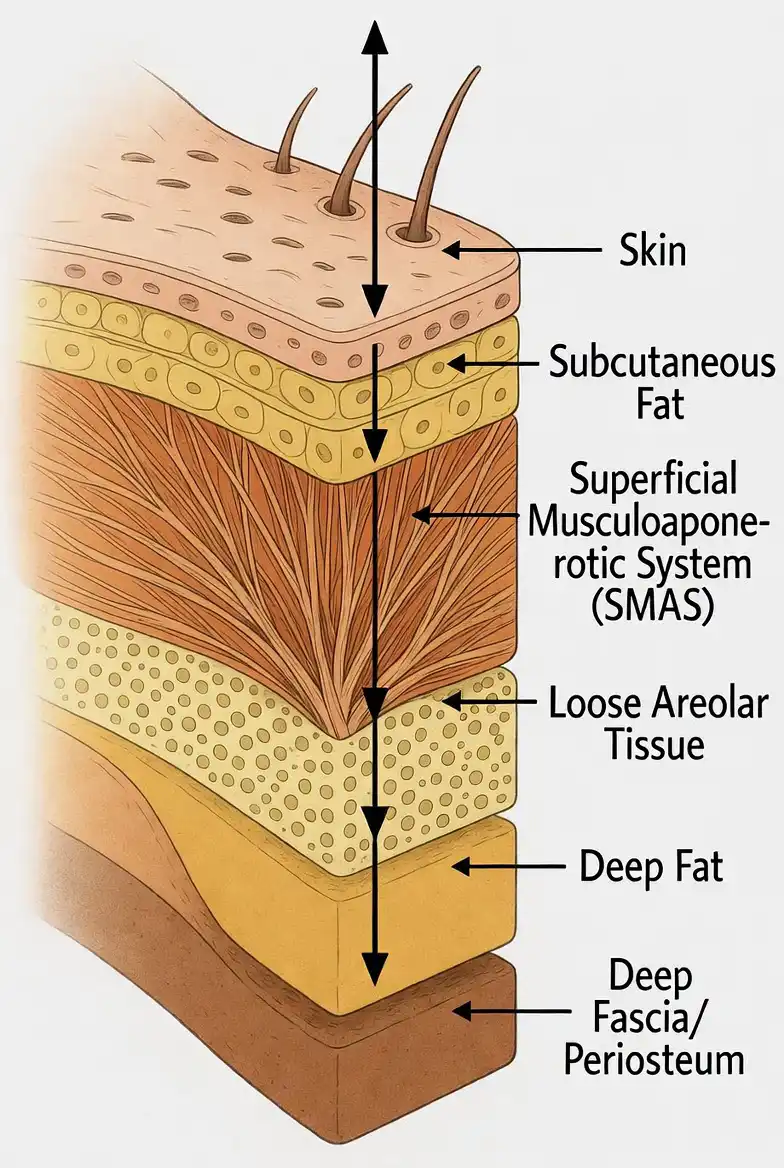
A mini facelift is performed in a more superficial plane, focusing on tightening the skin and limited subcutaneous tissue. Because dissection is conservative and retaining ligaments are typically not released, its ability to reposition deeper facial structures is modest. The result is a subtle improvement in early jowling and mild skin laxity, rather than a comprehensive structural change.
In contrast, the SMAS facelift operates at a deeper anatomical level by directly engaging the superficial musculoaponeurotic system (SMAS). By lifting and repositioning this layer—along with its continuity into the platysma of the neck—the procedure allows for more meaningful correction of lower facial descent. This deeper structural support contributes to improved jawline definition and longer-lasting contour enhancement, rather than relying primarily on skin tightening alone.
Patient Selection: Who Is a Candidate for Each Procedure?
Appropriate patient selection is a critical factor in determining the success of any facelift technique, as each procedure is designed to address a specific degree and pattern of facial aging.
Mini facelifts are generally indicated for patients with early-stage aging changes. These individuals typically present with mild skin laxity, early jowl formation, and little to no involvement of the neck. Skin quality is often favorable, with preserved elasticity, allowing for meaningful improvement without the need for extensive structural repositioning.
In contrast, the SMAS facelift is better suited for patients demonstrating more advanced lower facial aging. This includes moderate skin laxity, established jowling, and early to moderate neck involvement, often accompanied by descent of the deeper soft tissue layers. In these cases, addressing the SMAS is necessary to restore contour and provide durable support.
A common cause of suboptimal outcomes is the use of a limited procedure in patients who would benefit from deeper correction. When a mini facelift is applied to more advanced aging, the result may appear under-corrected due to the inability to adequately reposition underlying structures.
How to Evaluate Whether You Need a Mini or SMAS Facelift
The choice between a mini facelift and a SMAS facelift depends on how advanced facial aging is and how much structural correction is needed.
Results and Longevity: How Long Do Outcomes Last?
Longevity is closely tied to the depth of structural correction. Because the mini facelift relies more heavily on skin redraping and limited SMAS support, its results are generally shorter in duration. Over time, the effects of gravity and tissue laxity may reappear more quickly.
The SMAS facelift, by repositioning a deeper fibromuscular layer, provides more durable support. This reduces tension on the skin and contributes to longer-lasting results.
Outcomes in both procedures are influenced by surgical technique, tissue quality, and individual healing characteristics.
Recovery and Downtime Comparison
Recovery profiles differ in proportion to the extent of dissection and tissue manipulation.
Mini Facelift
- Shorter recovery period
- Less swelling and bruising
- Earlier return to social activity
SMAS Facelift
- Moderate recovery period
- More noticeable early swelling
- Slightly longer healing timeline
Despite these differences, both procedures are generally well tolerated when performed with appropriate technique.
Mini Facelift vs SMAS Facelift: Which Is Right for You?
The choice between a mini facelift and a SMAS facelift depends on the degree of anatomical aging rather than patient preference alone.
The mini facelift is most appropriate for early-stage aging where subtle refinement is sufficient. The SMAS facelift is better suited for patients requiring more meaningful structural repositioning.
Selection should be based on:
- Tissue laxity
- Depth of anatomical changes
- Desired longevity of results
Outcomes are influenced not only by procedural design but also by the surgeon’s expertise in selecting and executing the appropriate technique.
Mini Facelift vs SMAS Facelift: Side-by-Side Comparison
Below is a structured comparison of the mini facelift and SMAS facelift, highlighting the primary differences in technique, anatomical depth, and expected outcomes.
| Feature | Mini Facelift | SMAS Facelift |
|---|---|---|
| Depth of Dissection | Primarily superficial (skin ± limited SMAS) | SMAS layer routinely addressed |
| SMAS Manipulation | Minimal or selective plication | Plication, imbrication, or SMASectomy |
| Extent of Dissection | Limited | Moderate |
| Degree of Correction | Mild improvement | Moderate, structural improvement |
| Longevity of Results | Shorter-term | Longer-lasting |
| Recovery Time | Shorter (≈ 1–2 weeks social downtime) | Moderate (≈ 2–3 weeks social downtime) |
| Ideal Candidate | Early aging, mild laxity | Moderate aging, visible jowling |
| Neck Improvement | Limited | Moderate (often combined with neck work) |
References
- Mitz V, Peyronie M. The superficial musculo-aponeurotic system (SMAS) in the parotid and cheek area. Plastic and Reconstructive Surgery. 1976.
- Baker DC. Minimal incision rhytidectomy (short scar facelift). Aesthetic Surgery Journal.
- Aston SJ, Steinbrech DS, Walden JL. Aesthetic Plastic Surgery. Elsevier.
- Neligan PC. Plastic Surgery: Volume 2: Aesthetic Surgery. Elsevier.